

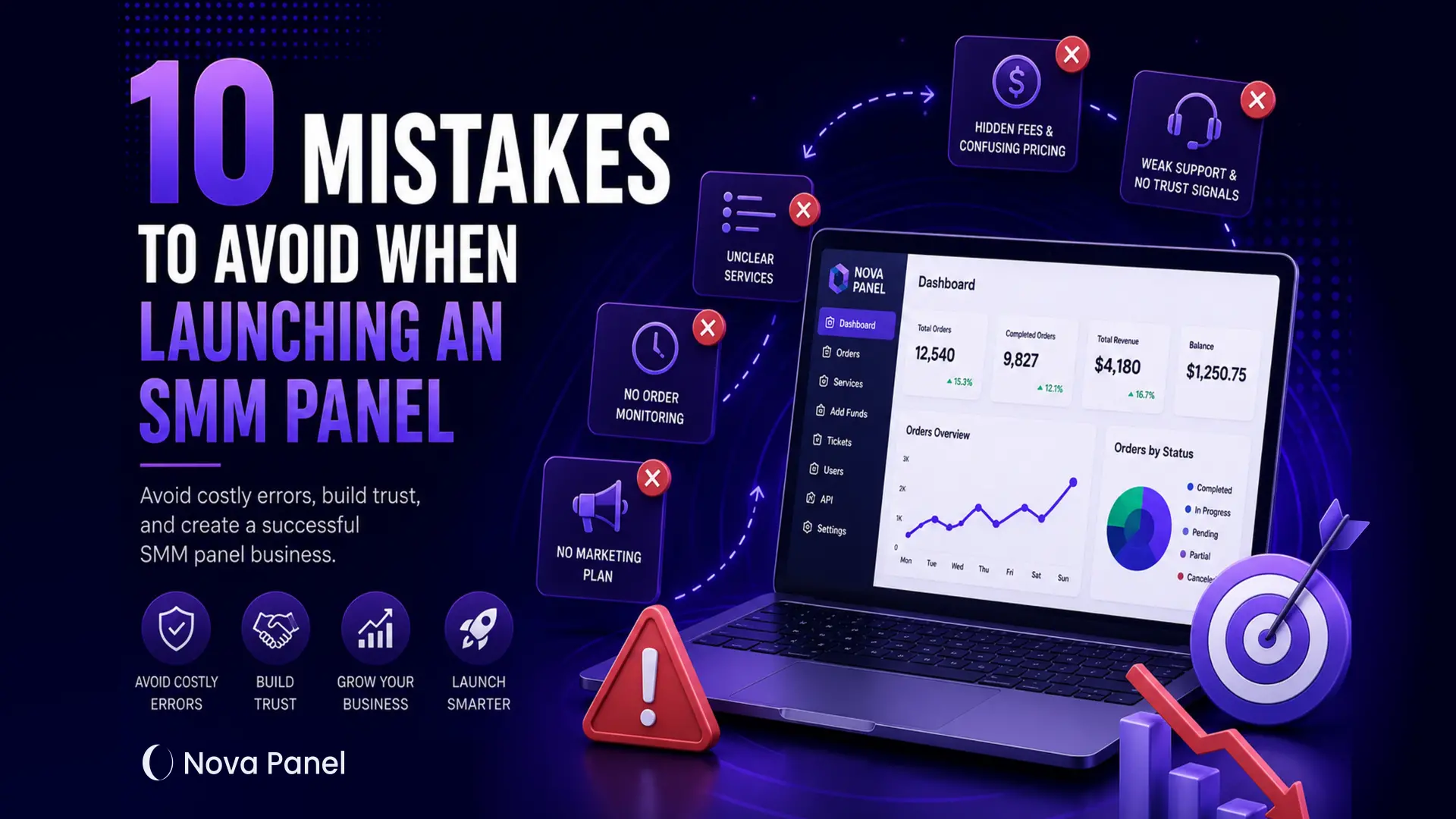
10 Mistakes to Avoid When Launching an SMM Panel
Launching an SMM panel can look simple from the outside.
You create a website, add services, connect payments, publish prices, and wait for customers.
But in reality, a successful SMM panel business needs more than a service list and a checkout page. It needs a clear audience, organized catalog, smart pricing, smooth payment flow, simple order process, reliable support, and automation that actually helps the business grow.
Many new panel owners make the same mistakes at the beginning. They try to launch too fast, add too many services, copy competitors blindly, ignore margins, or rely on manual work for too long.
These mistakes can lead to confused customers, low profit, too many support tickets, delayed orders, and weak trust.
The good news is that most of these mistakes can be avoided if you plan your SMM panel properly from the start.
In this guide, we will look at 10 common mistakes to avoid when launching an SMM panel and explain how to build a stronger foundation for long-term growth.
Mistake 1: Launching Without a Clear Target Audience
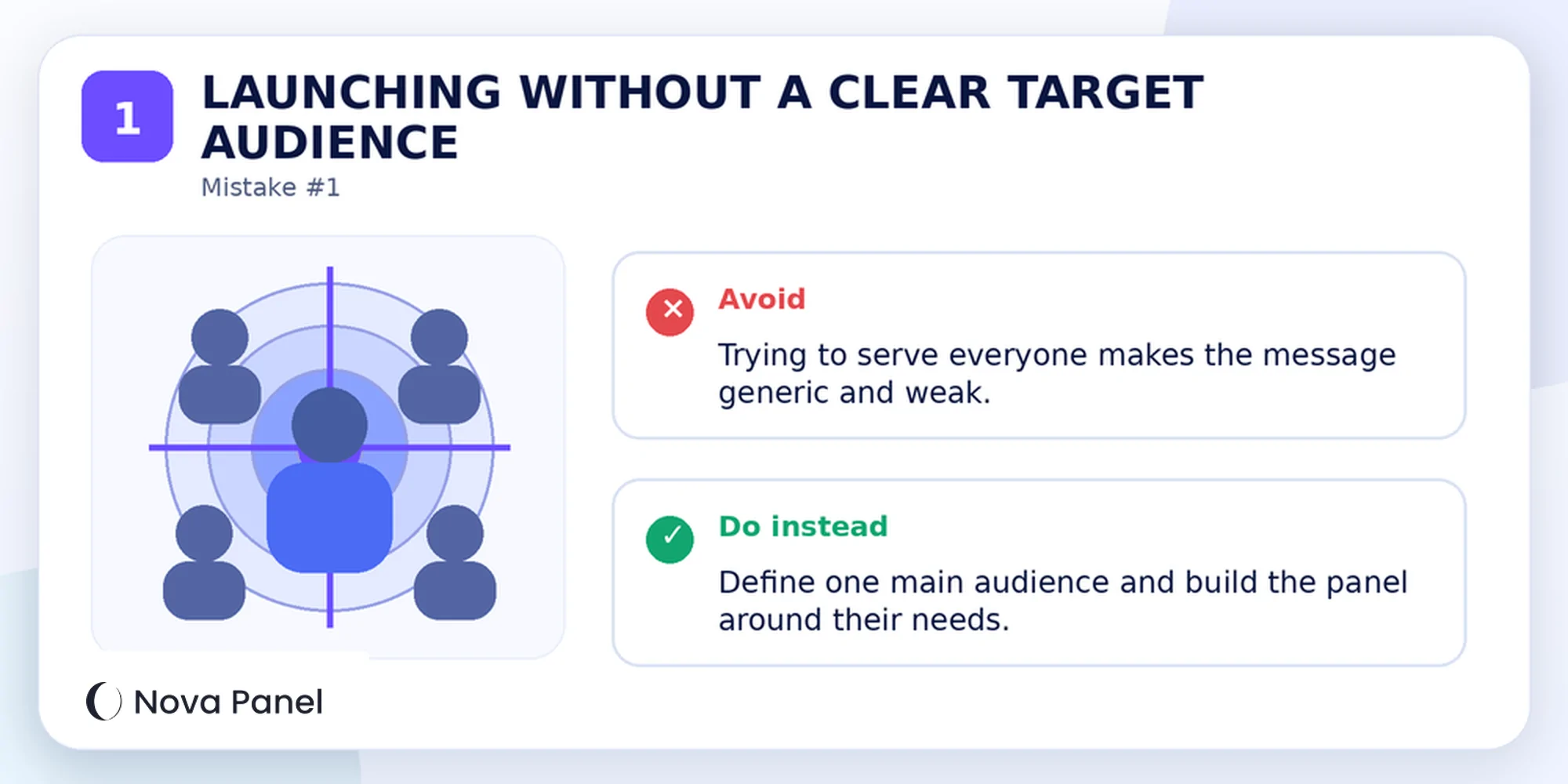
One of the biggest mistakes is trying to serve everyone.
Many beginners launch an SMM panel with generic messaging, a huge list of services, and no clear customer focus. They hope that agencies, resellers, freelancers, creators, and small businesses will all understand the offer immediately.
But different customer groups have different needs.
A reseller may care about margins, repeat orders, and fast navigation.
An agency may care about workflow, order history, and client organization.
A beginner may care about simple explanations and a clean dashboard.
A business owner may care about trust, support, and clear pricing.
If your panel tries to speak to everyone at once, the message becomes weak.
Before launching, ask:
Who is this panel mainly built for?
Then ask:
What problem does this panel solve for that audience?
A clear audience helps you make better decisions about services, pricing, website copy, support, and content.
You do not need to exclude every other customer type forever. But at launch, focus makes your business easier to understand and easier to promote.
Mistake 2: Adding Too Many Services Too Early
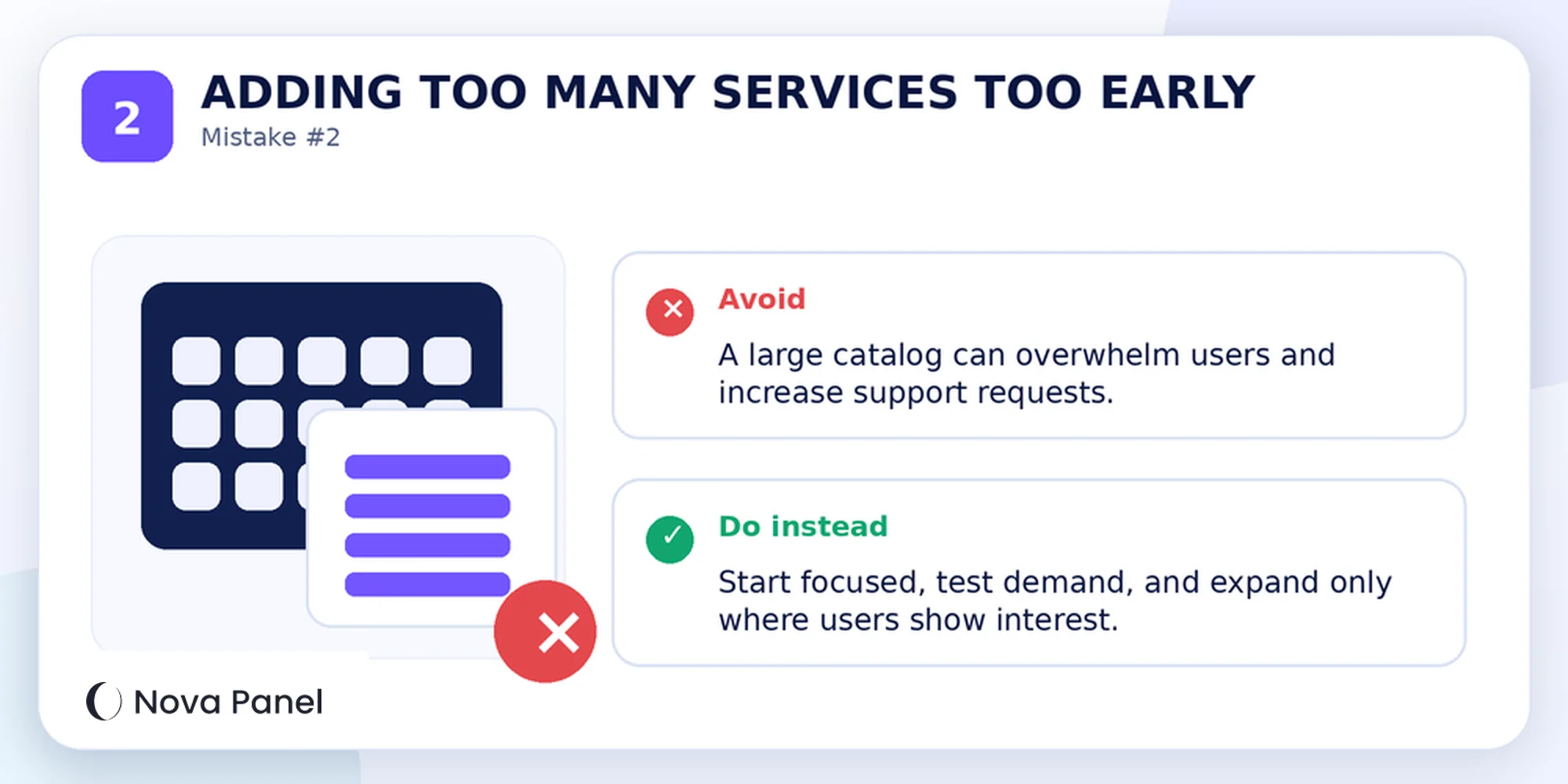
A large service catalog may look impressive, but it can also hurt your launch.
Many new panel owners add hundreds or thousands of services before they understand customer demand. The result is often a confusing catalog with unclear names, weak descriptions, overlapping categories, and inconsistent quality.
More services do not automatically mean more sales.
A better approach is to start with a focused catalog.
Your first service list should be:
- easy to understand
- clearly organized
- aligned with your target audience
- simple to price
- manageable from a support perspective
- tested before heavy promotion.
A focused catalog helps users find what they need faster.
It also helps you learn which services people actually order, which ones create support problems, and which categories deserve expansion later.
The best catalog is not the biggest catalog.
The best catalog is the one customers can understand, trust, and use again.
Mistake 3: Using Unclear Service Names and Descriptions
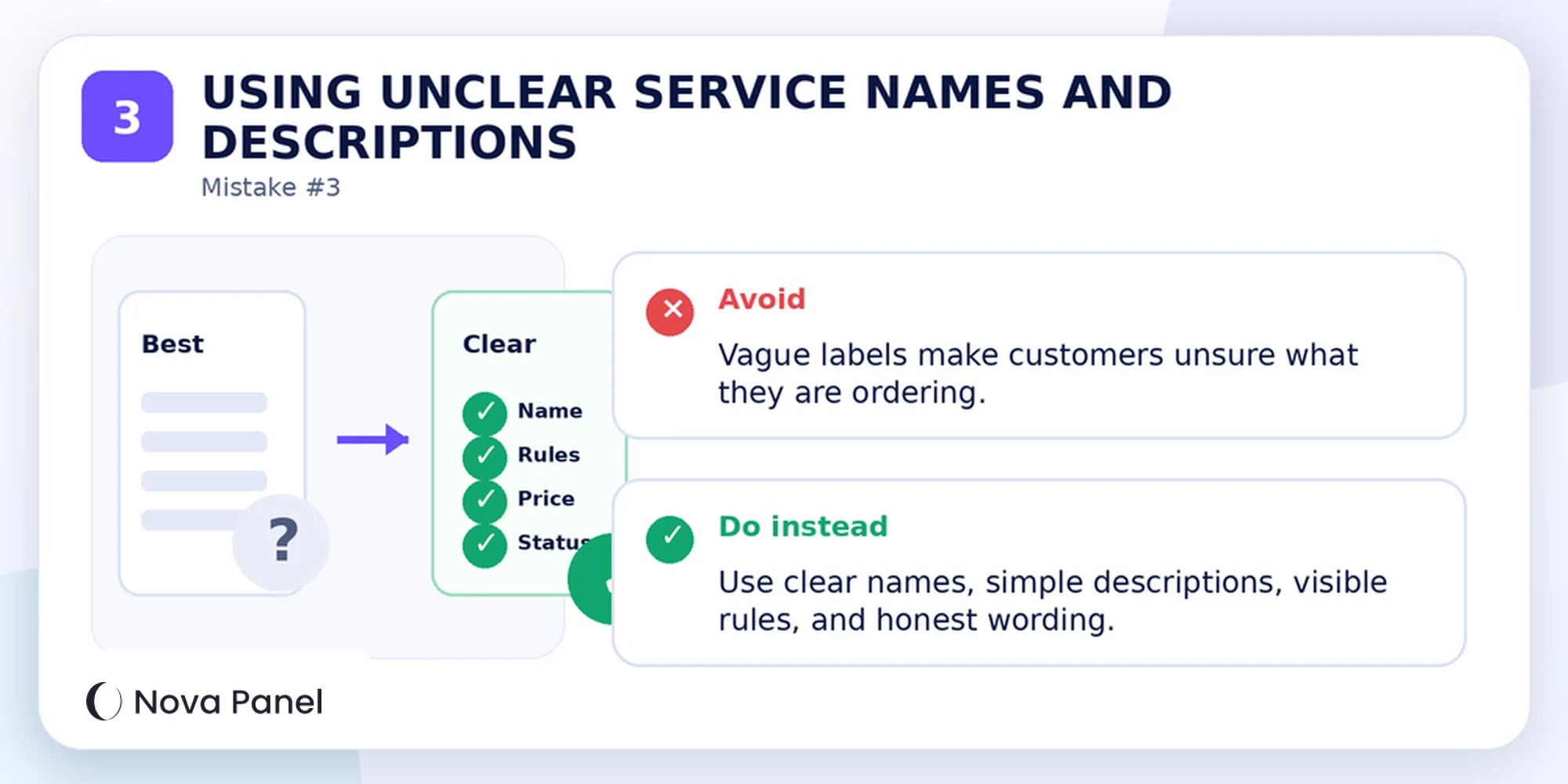
Customers should not need to guess what they are ordering.
If your service names are vague, overly technical, or filled with unclear abbreviations, users may hesitate before placing an order. If descriptions are missing or too generic, they may contact support for basic questions or leave the platform entirely.
Every service should clearly explain:
- what the service is
- who it is for
- what information the customer must provide
- minimum and maximum order limits
- important rules or restrictions
- what status updates mean
- what happens if an order is partial or canceled.
Avoid descriptions like:
“Best quality service.”
That does not explain anything.
Use simple and useful language instead:
“Suitable for users who want a clear entry-level option in this service category.”
Good descriptions reduce confusion.
They also reduce support work because customers can make decisions without asking the same questions again and again.
Mistake 4: Copying Competitor Pricing Blindly
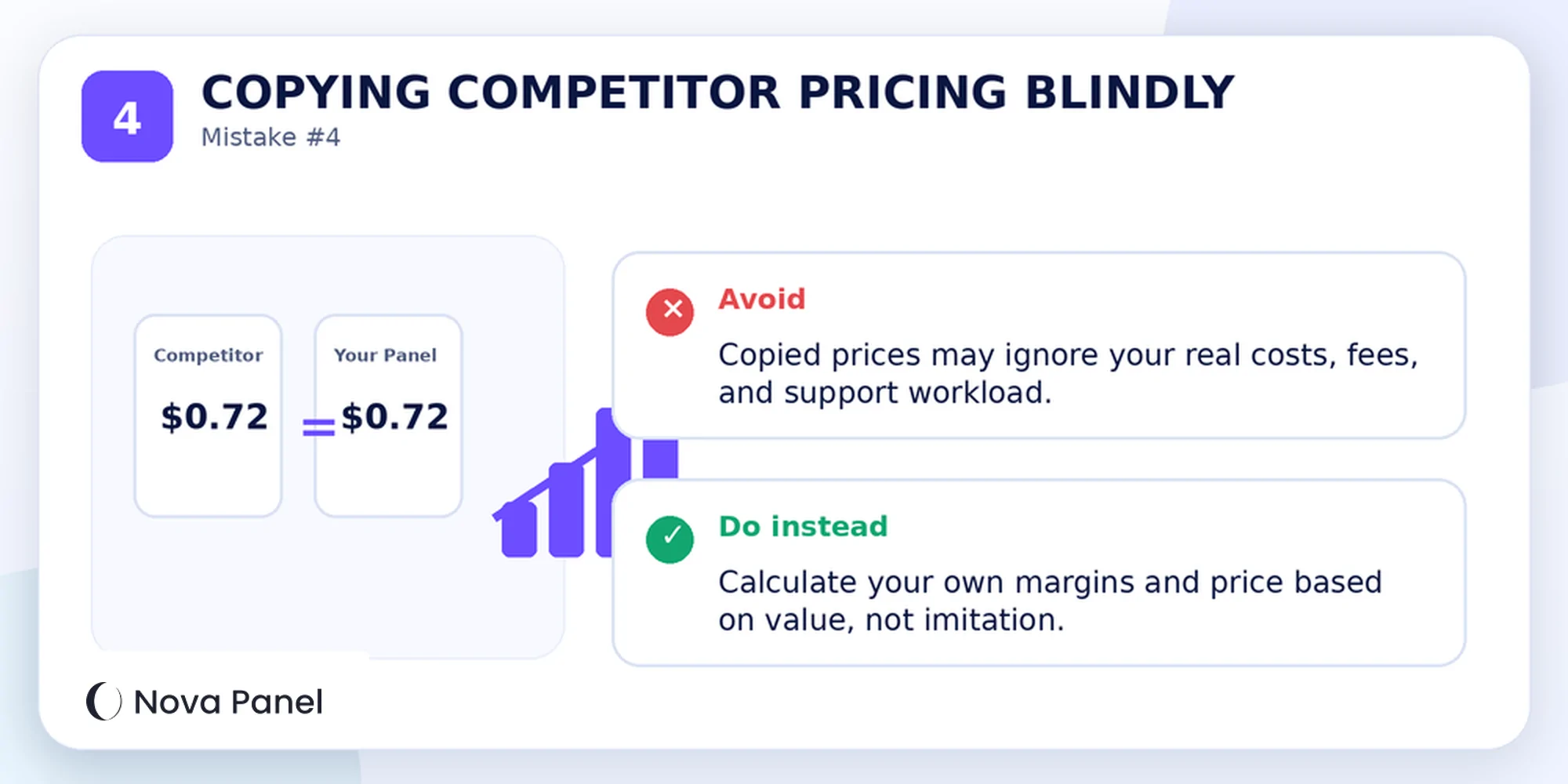
Looking at competitors is useful.
Copying them blindly is dangerous.
You do not know their real costs, payment fees, support workload, refund rate, supplier conditions, customer base, or business model.
A competitor may have lower costs than you.
They may be running a temporary promotion.
They may be underpricing to attract users.
They may not understand their own margins.
If you simply copy their prices, you may build a business that looks competitive but is not profitable.
A healthy SMM panel pricing strategy should consider:
- base service cost
- payment fees
- support time
- refund and partial order risk
- operational costs
- desired profit margin
- customer type
- reseller discounts
- market positioning.
Being cheap can attract attention, but being too cheap can create problems.
Instead of competing only on price, compete on clarity, trust, support, smooth payments, organized services, and a better customer experience.
Customers do not only pay for the service itself.
They also pay for convenience and confidence.
Mistake 5: Ignoring Payment Fees and Balance Flow
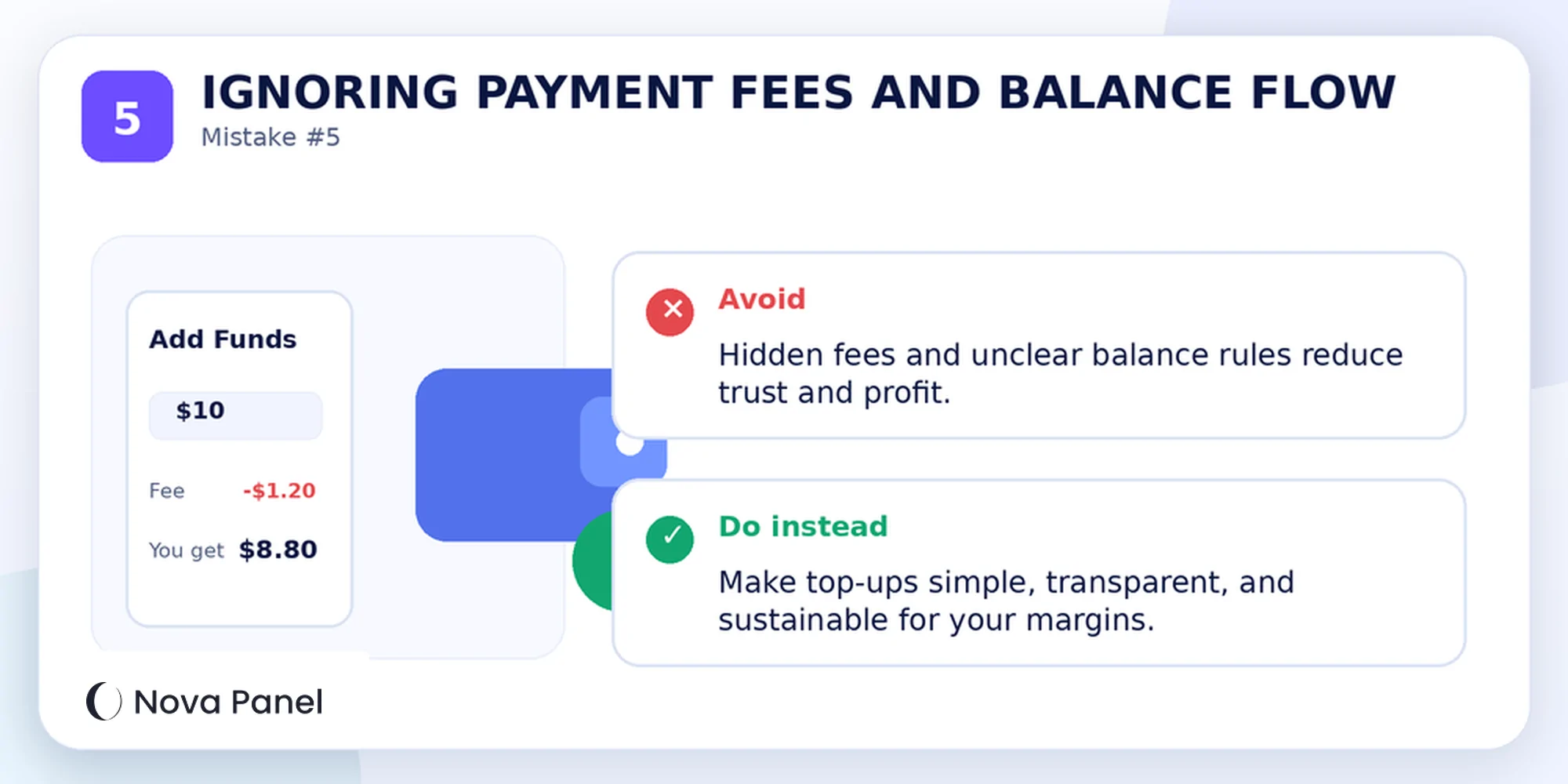
Payments are one of the most important parts of an SMM panel business.
If users want to add funds but the process feels confusing, slow, or unreliable, they may not complete the top-up.
A weak payment flow can create problems such as:
- abandoned top-ups
- customer confusion
- support tickets
- payment confirmation delays
- unclear balance rules
- reduced trust.
Your balance flow should be simple:
- The user chooses a top-up amount.
- The user selects a payment method.
- The payment is processed.
- The balance updates.
- The user can place an order.
You should also make your payment rules clear.
Explain:
- minimum top-up amount
- supported payment methods
- supported currencies, if relevant
- refund rules
- balance terms
- what happens if payment confirmation is delayed
- how users can contact support for payment issues.
Payment fees also matter.
If you allow very small top-ups, fixed payment fees can reduce your real margin. That is why minimum top-up amounts can help protect profitability and keep the business more sustainable.
A clean payment experience builds confidence.
A confusing payment experience creates doubt.
Mistake 6: Making the Order Process Too Complicated
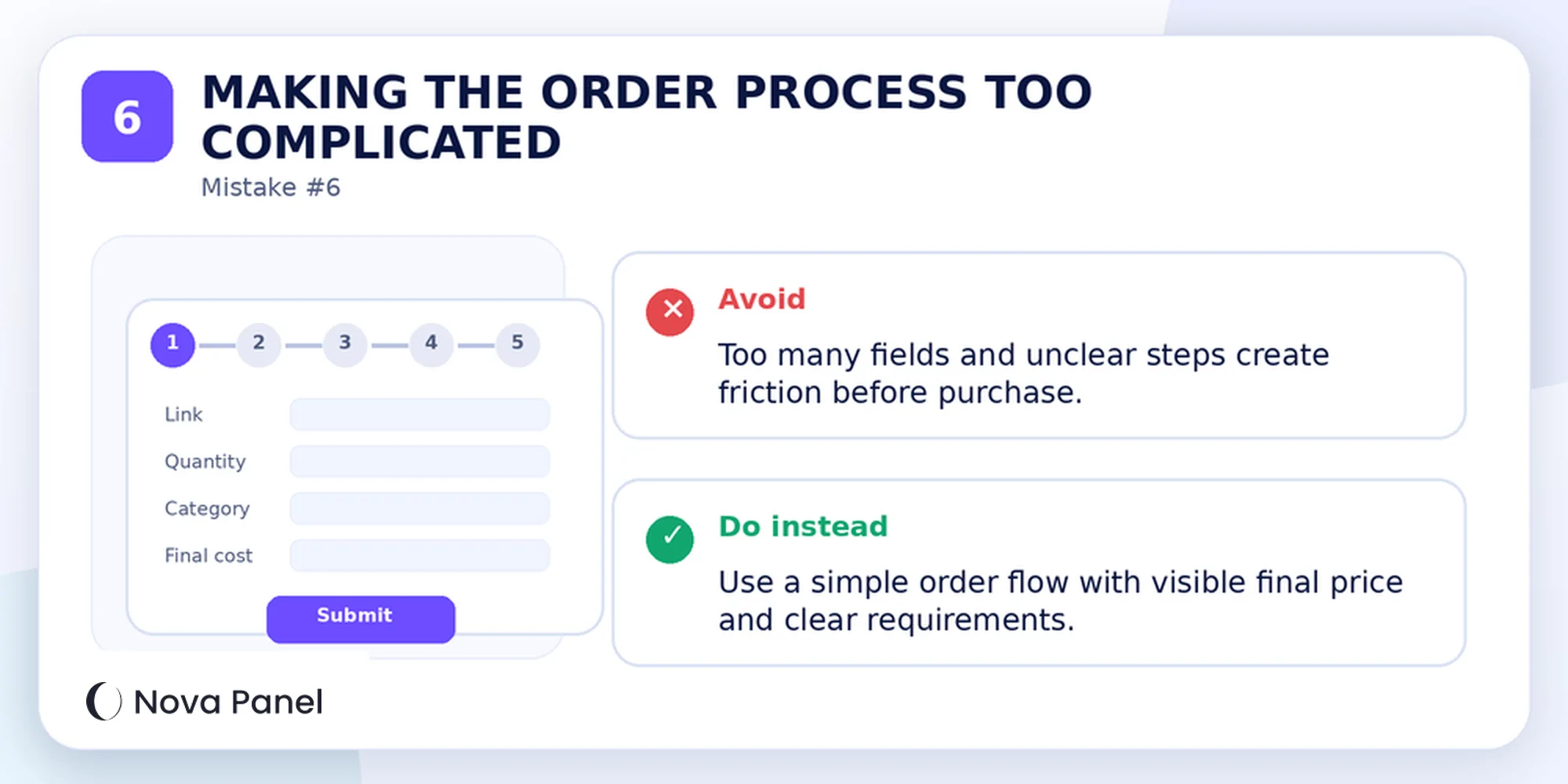
A user should be able to place an order without contacting support.
If the order process is confusing, you lose conversions and create unnecessary support work.
A strong order flow should be simple:
- Choose a category.
- Select a service.
- Enter the required details.
- Check quantity and price.
- Submit the order.
- Track the status.
The user should always understand what is happening.
Avoid forms with unclear fields, hidden rules, or confusing final prices.
Before launching, test the order process as if you were a first-time user.
Ask:
- Is it clear what to click?
- Is the service description understandable?
- Is the price visible before submission?
- Is the required input format explained?
- Is the final cost shown clearly?
- Can the user find the order status afterward?
A simple order process makes your panel feel professional.
A complicated order process makes users nervous.
Mistake 7: Not Showing Clear Order Statuses
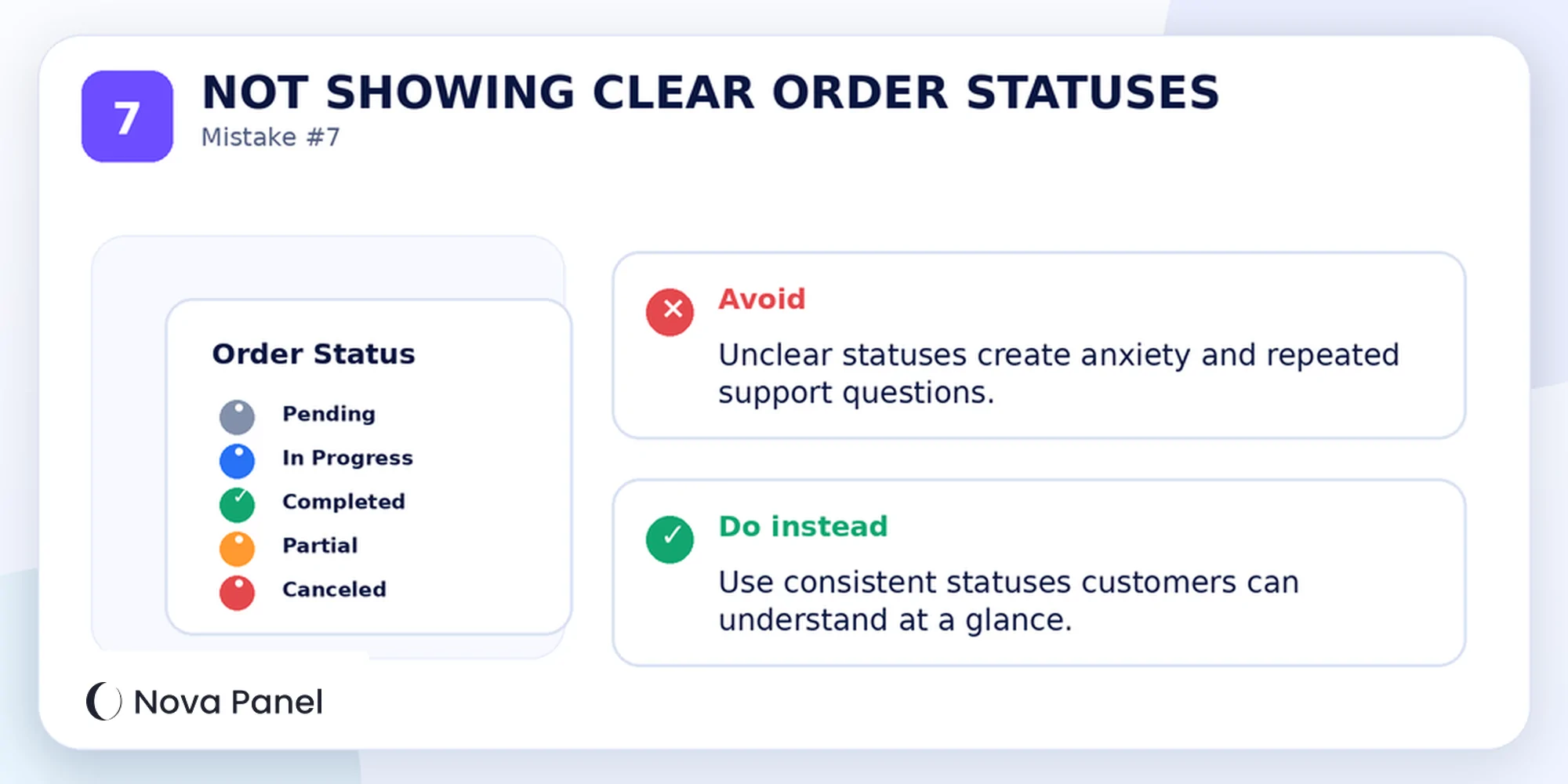
After placing an order, customers want to know what is happening.
If they cannot see order progress, they will contact support.
This creates pressure on your team and makes the business feel less organized.
Clear order statuses reduce confusion.
Common statuses may include:
- Pending
- In Progress
- Completed
- Partial
- Canceled.
The important thing is consistency.
Do not show confusing technical messages to customers. Do not use different status names for the same situation. Do not leave users guessing.
If an order is delayed, partial, or canceled, the customer should be able to understand the basic meaning without reading technical documentation.
Good status tracking improves trust.
It shows users that the system is active and that their order has not disappeared.
For the owner, clear statuses reduce repetitive support questions and make order management easier.
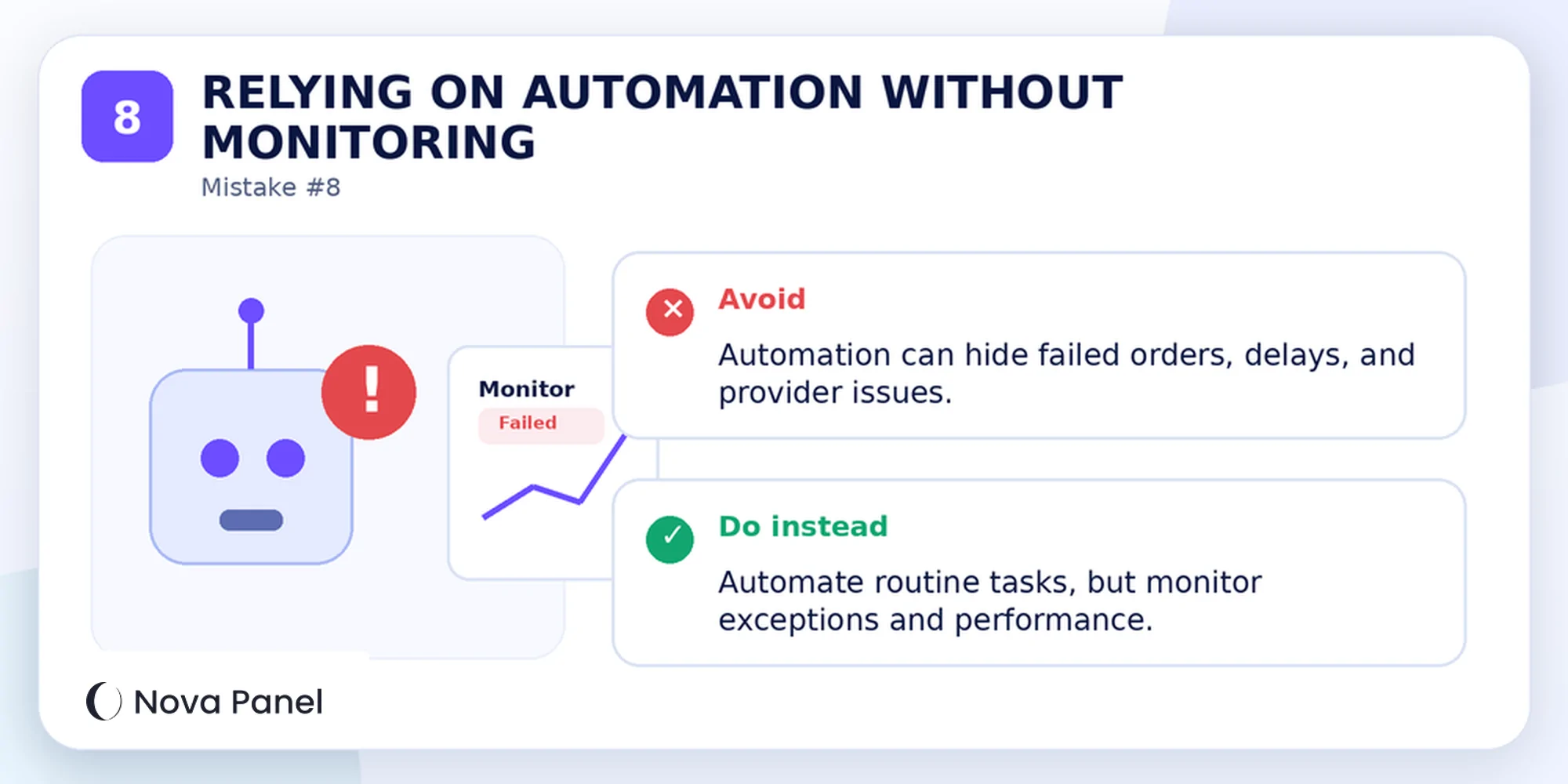
Mistake 8: Relying on Automation Without Monitoring
Automation is one of the biggest advantages of an SMM panel.
It can help with order processing, balance flow, status updates, and service management.
But automation is not magic.
A mistake many beginners make is thinking:
“Once automation is connected, I do not need to monitor anything.”
That is not true.
Even with automation, you still need to monitor:
- failed orders
- delayed orders
- partial orders
- canceled orders
- payment issues
- provider performance
- service quality
- customer complaints
- unusual activity.
Automation reduces manual work, but it does not remove responsibility.
The best approach is:
automate routine actions and monitor important exceptions.
This way, your panel can handle repetitive processes efficiently while you still keep control over quality and customer experience.
A good SMM panel owner does not process every order manually forever.
But they also do not ignore the system after launch.
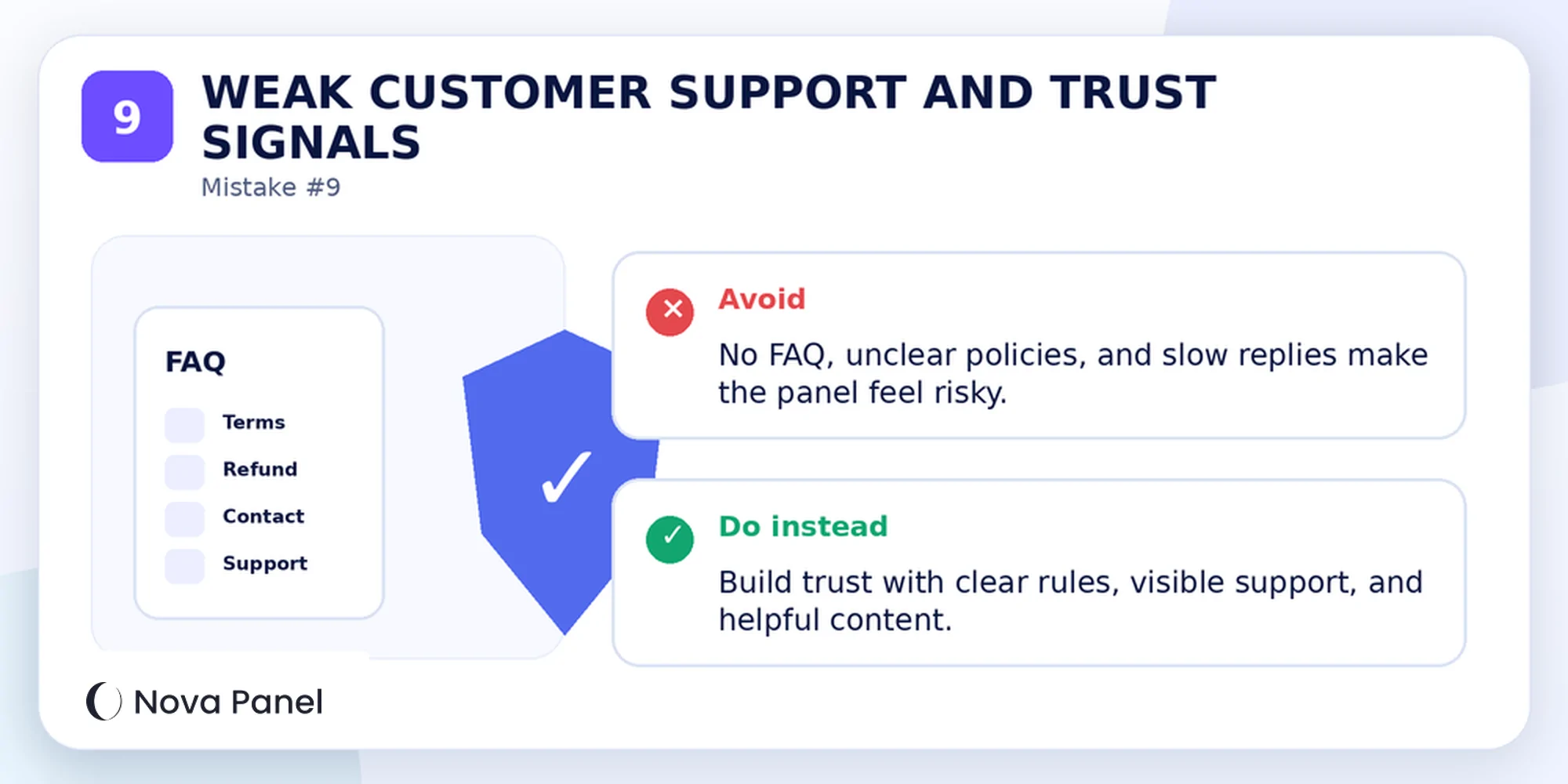
Mistake 9: Weak Customer Support and Trust Signals
A new SMM panel needs trust.
Customers want to know that the business is real, active, and organized.
If your website looks incomplete, has no clear rules, no support information, no FAQ, and no useful content, users may hesitate before adding balance.
Trust signals can include:
- clear FAQ section
- Terms of Service
- refund and balance rules
- visible order statuses
- clear service descriptions
- professional website design
- educational blog content
- fast and polite support responses
- transparent payment instructions.
Support does not need to be complicated at the beginning.
But it needs to be clear and responsive.
Even a well-automated platform will still receive questions.
The goal is not to eliminate support completely.
The goal is to reduce unnecessary support requests by making the platform easier to understand.
A helpful FAQ, clear rules, and organized service descriptions can prevent many problems before they happen.
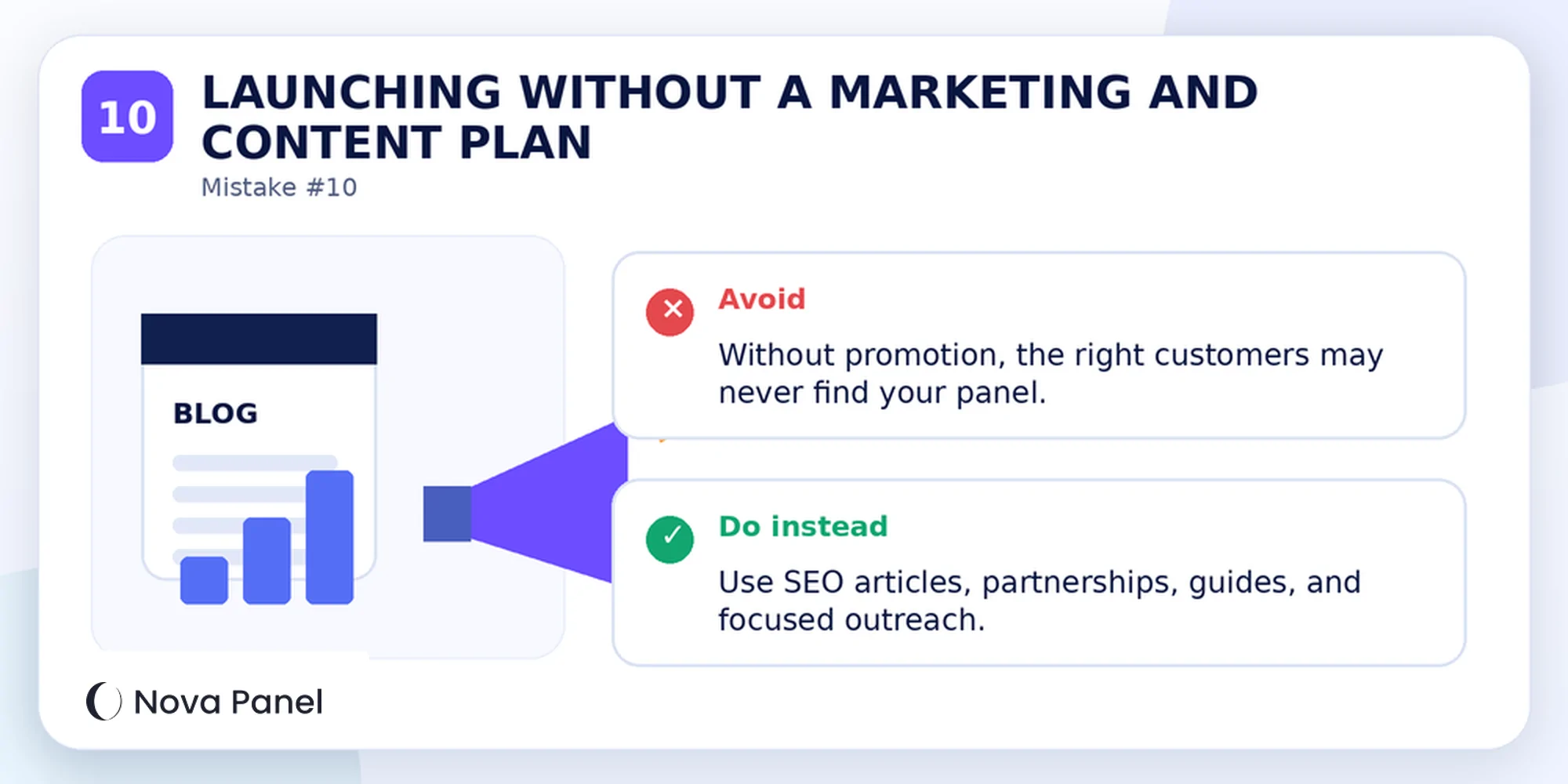
Mistake 10: Launching Without a Marketing and Content Plan
Some panel owners spend all their time on the platform but forget about customer acquisition.
They launch the panel and expect customers to appear.
That rarely happens.
A good SMM panel business needs a marketing plan.
At the beginning, you can focus on a few practical channels:
- SEO content
- blog articles
- existing network
- partnerships
- reseller outreach
- community promotion
- educational guides
- targeted landing pages.
Your blog can play an important role.
Articles such as:
- What Is an SMM Panel and How Does It Work?
- How to Start Your Own SMM Panel Business
- SMM Panel Pricing Strategy
- How to Choose the Right SMM Services
- API Integration for SMM Panels
- Custom SMM Panel vs Ready-Made Platform
can help attract users who are already researching the topic.
Content is not only for SEO.
It also shows that your company understands the market and can explain it clearly.
A website with useful articles feels more active and trustworthy than a website with only a pricing page.
If you want users to trust your panel, you need to educate them, guide them, and show that the business is alive.
Bonus Mistake: Building Everything From Scratch Too Early
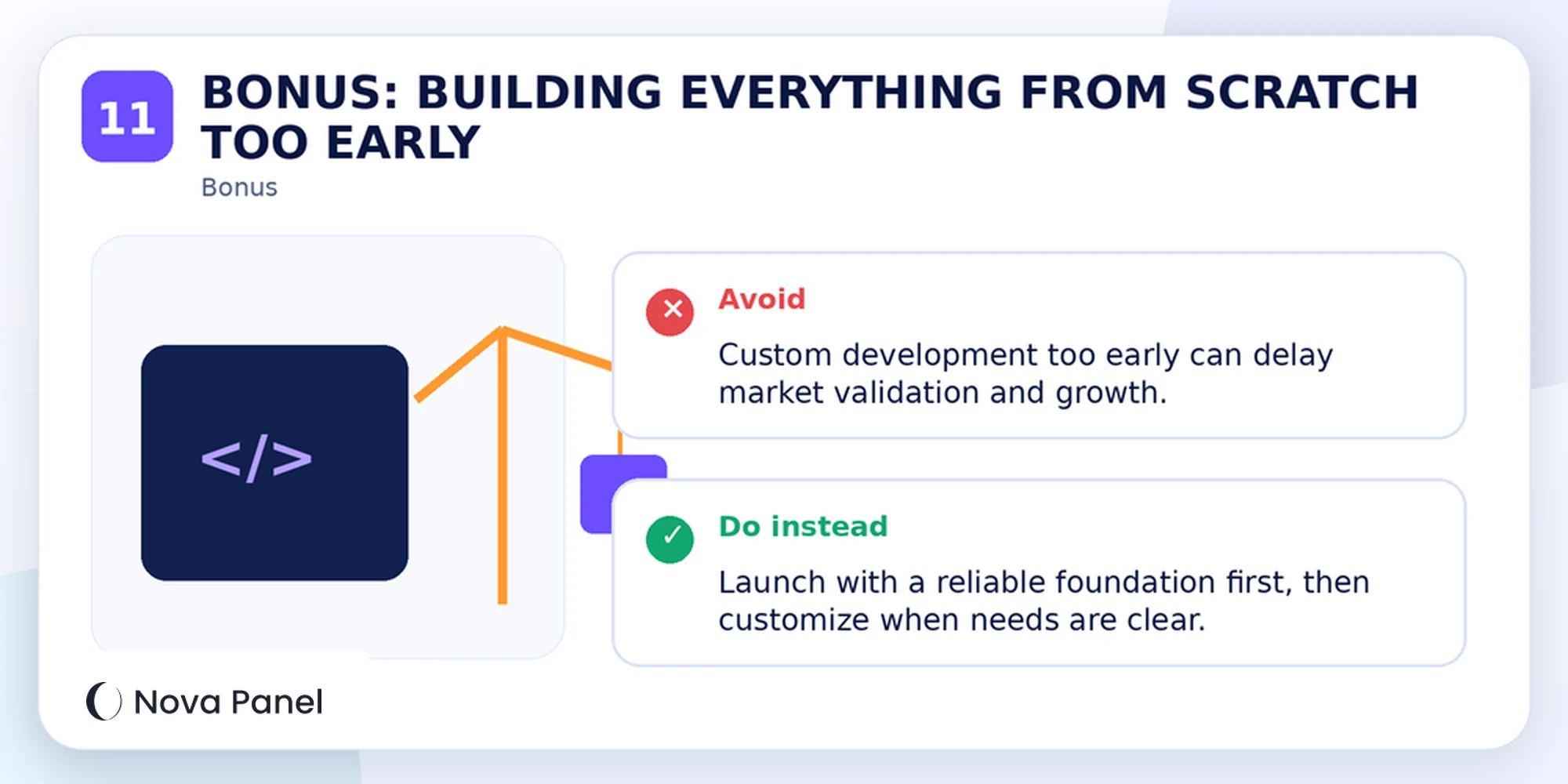
Custom development can be useful for mature businesses with clear requirements, a technical team, and enough budget.
But many beginners try to build everything from scratch before validating the business.
This can create delays, extra costs, technical problems, and months of development before the first real customer appears.
At the early stage, your priority should be:
- launch faster
- test demand
- understand your audience
- organize your services
- improve pricing
- get feedback
- build trust
- grow step by step.
Building from scratch may give more control, but it also creates more responsibility.
For many new SMM panel businesses, a ready-made platform is a more practical starting point.
It allows you to focus on customers and growth instead of spending all your energy on technical infrastructure.
How Nova Panel Helps You Avoid These Mistakes
Nova Panel is designed for entrepreneurs who want to launch and manage an SMM panel without building the full system from scratch.
Many launch mistakes happen because the business does not have a proper structure.
Orders are handled manually.
Payments are unclear.
Services are disorganized.
Customers do not understand statuses.
The owner spends too much time on repetitive tasks.
Nova Panel helps provide the foundation for a more organized SMM panel business, including:
- customer dashboard
- service catalog
- order management
- balance top-ups
- payment flow
- user accounts
- account settings.
This allows you to focus on the business decisions that matter most:
- choosing the right audience
- organizing services clearly
- setting profitable pricing
- improving customer experience
- building trust
- publishing useful content
- supporting users
- scaling over time.
A strong platform does not replace strategy.
But it gives you a better foundation to execute that strategy.
Nova Panel gives you the tools to launch faster, manage your SMM panel more easily, and avoid many common problems that slow down new panel owners.
Final Thoughts
Launching an SMM panel is not only about adding services and accepting payments.
It is about building a system that customers can understand, trust, and use again.
The most common mistakes usually come from lack of structure:
- unclear audience
- messy service catalog
- weak descriptions
- poor pricing
- confusing payments
- complicated order process
- unclear statuses
- unmonitored automation
- weak support
- no marketing plan.
Avoiding these mistakes does not guarantee instant success, but it gives your business a much stronger foundation.
Start focused.
Keep the catalog clear.
Price responsibly.
Make payments simple.
Track orders properly.
Support customers.
Use automation carefully.
Publish useful content.
Improve based on real data.
The best SMM panel is not the one with the most services.
The best SMM panel is the one that feels organized, transparent, and easy to use.
Nova Panel gives you the tools to launch and manage your own SMM panel without building everything from scratch.
FAQ
What is the biggest mistake when launching an SMM panel?
One of the biggest mistakes is launching without a clear target audience. If you do not know who your panel is for, it becomes harder to choose services, set prices, write website copy, and attract customers.
Should I add many services when launching an SMM panel?
Not necessarily. A large catalog can confuse users if it is poorly organized. It is usually better to start with a focused service list, test demand, and expand based on real customer behavior.
Why is pricing important for an SMM panel?
Pricing affects profitability, customer expectations, support workload, and brand positioning. If prices are too low, you may lose margin. If they are too high without clear value, customers may not order. If pricing is confusing, users may leave before topping up.
Why do SMM panels need clear order statuses?
Clear order statuses help customers understand what is happening after they place an order. This reduces support questions and makes the panel feel more organized and trustworthy.
Is automation enough to run an SMM panel successfully?
No. Automation helps reduce manual work, but you still need to monitor failed orders, delays, service quality, provider performance, customer feedback, and support issues.
Do I need a blog for my SMM panel?
A blog is useful because it helps with SEO and trust. Educational articles can attract users who are researching SMM panels and show that your business is active, knowledgeable, and professional.
Can Nova Panel help me launch an SMM panel faster?
Nova Panel gives you the structure to manage key parts of an SMM panel business, including dashboard, services, orders, balance top-ups, payment flow, user accounts, and account settings. This helps you launch faster and focus more on growth instead of building everything from scratch.